Falco peregrinus
Type: bird
Status: threatened
Species Guide
Peregrine falcon
Falco peregrinus
Species Type: bird
Conservation Status: threatened
Identification
The peregrine falcon, also known as the duck hawk, is the largest falcon in New Jersey, and the world’s fastest animal, capable of flying at speeds over 200 miles an hour. Like other falcons, peregrines can be distinguished by their long pointed wings and exceptional flight speed. Adult peregrines have slate gray to bluish backs and a light-colored breast with a fine brown horizontal barring that becomes lighter with age. Immature peregrine falcons are brown above with a light colored breast that is streaked vertically with brown markings.
Female peregrine falcons are larger than males. Males are commonly called tiercels, because they are about one third smaller than females.
Distribution & Habitat
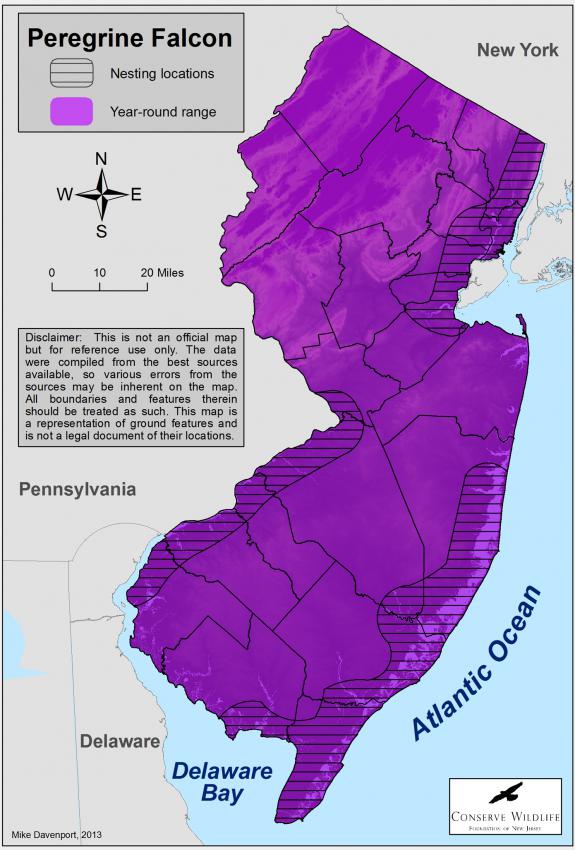
Historically, peregrine falcons nested on the cliffs of the Palisades and the Delaware Water Gap. Today, in New Jersey, peregrines nest atop man made platforms along the Atlantic coast from Ocean to Cape May counties and on bridges spanning the Delaware and Hudson Rivers. Peregrine falcons also nest atop buildings in cities such as Jersey City, Newark, and Atlantic City. In recent years, peregrine falcons have returned to the cliffs of the Palisades along the Hudson River.
Although peregrine falcons are found worldwide, taxonomists have classified birds from various regions as subspecies, similar to races in humans. In New Jersey, the eastern subspecies, anatum, predominates, although since its reintroduction to the wild, it also includes strains of the tundra (northern Canada) and Peale’s (western) races.
Diet
Superior wing speed makes the peregrine falcon extremely proficient at catching avian prey in flight. In New Jersey, their diet consists primarily of pigeons, songbirds, shorebirds and ducks. Peregrines hunt by soaring high above their prey. Once their target is singled out, they fold their wings and drop (called a stoop) headlong toward it. As the peregrine reaches its prey, its wings are extended in a braking motion while the legs are thrust forward in a pendulum motion. The prey is usually killed by the impact of this mid-air collision. If the impact does not kill their prey, the falcon comes equipped with a tomial tooth. It is designed so that a quick, fatal bite can be delivered to the prey, usually on the neck to end a struggle as quickly as possible.
Life Cycle
Most peregrines nesting in New Jersey are.jpg’esident birds that remain near the nest site throughout the entire year. Courtship begins in early March with aerial displays and the male bringing food to the female. Peregrine nests, known as scrapes, consist of a simple depression in a gravel substrate. Egg laying occurs between late March and the end of April when the female will deposit a clutch of three to four eggs. Incubation occurs only after all of the eggs have been laid and lasts 32 to 33 days. The female usually performs most of the incubation responsibilities with the male occasionally participating. After hatching, the young are totally dependent upon their parents until they are ready to fly in approximately seven weeks. Upon fledging, or leaving the nest, the young remain dependent, to a degree, on the adults until they master their flight and hunting skills.
Current Threats, Status, and Conservation
During the 1940s, an estimated 350 pairs of peregrines nested east of the Mississippi River, with perhaps five pairs nesting in the Garden State. Historic records indicate that peregrines once nested on the cliffs above the Delaware Water Gap and on the Palisades overlooking the Hudson River.
The decade of the 1950s saw the widespread use of DDT to control mosquitoes and other insect pests. This poison gradually entered food chain – peregrines and other birds of prey where harmed by it when they ate animals that had themselves consumed the toxin. DDT caused young peregrine chicks to die early, or it caused the adult peregrines to lay thin-shelled eggs that cracked under the female’s weight when she tried to incubate them. By 1964, peregrines had completely disappeared from the eastern half of the country, prompting federal and state governments to list the species as endangered.
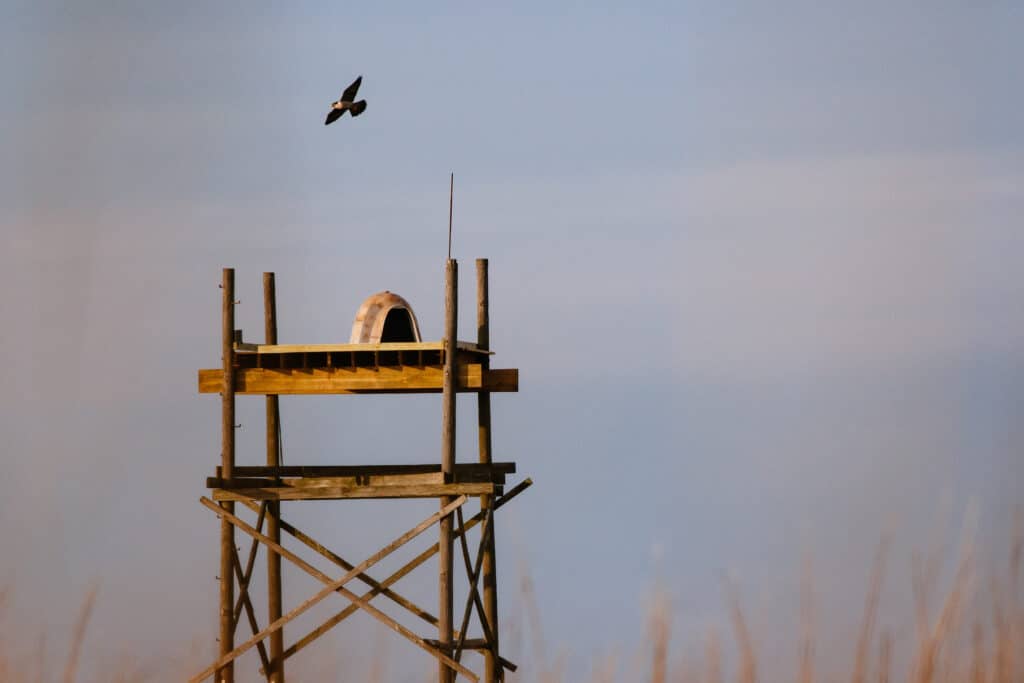
With the ban of DDT in 1972, there was renewed hope for the recovery of peregrine populations. In 1975 the Division of Fish and Wildlife begin a restoration program in New Jersey. Young peregrines were bred in captivity and released gradually through a hacking process along the coast. Although the coastal marshes were not considered typical nesting habitat, an abundant prey base and freedom from predation by great horned owls provided a unique opportunity to restore the peregrine population. Hacking continued between 1975 and 1980. In 1980 the first wild nesting occurred at Forsythe National Wildlife Refuge in Brigantine, Atlantic County. Today, the peregrine’s recovery in the Garden State continues at a slow but steady pace. In 2009, 24 known nests were monitored in New Jersey. Additionally, offspring from New Jersey falcon nests have been relocated to other states such as West Virginia, thereby accelerating the recovery process along the east coast.
New Jersey’s peregrine falcon population is monitored closely by the biologists. Each year biologists band young falcons and gather information on nesting success and productivity. Biologists continue to monitor the population to detect the presence of environmental contaminants. Since the majority of our adult population does not migrate, their health serves as a good indicator of the quality of our environment. Environmental contaminants such as pesticides, PCBs and heavy metals continue to threaten sensitive components of our ecosystem, including the peregrine falcon. Peregrines and other sensitive species continue to serve as important indicators of the health of New Jersey’s environment.
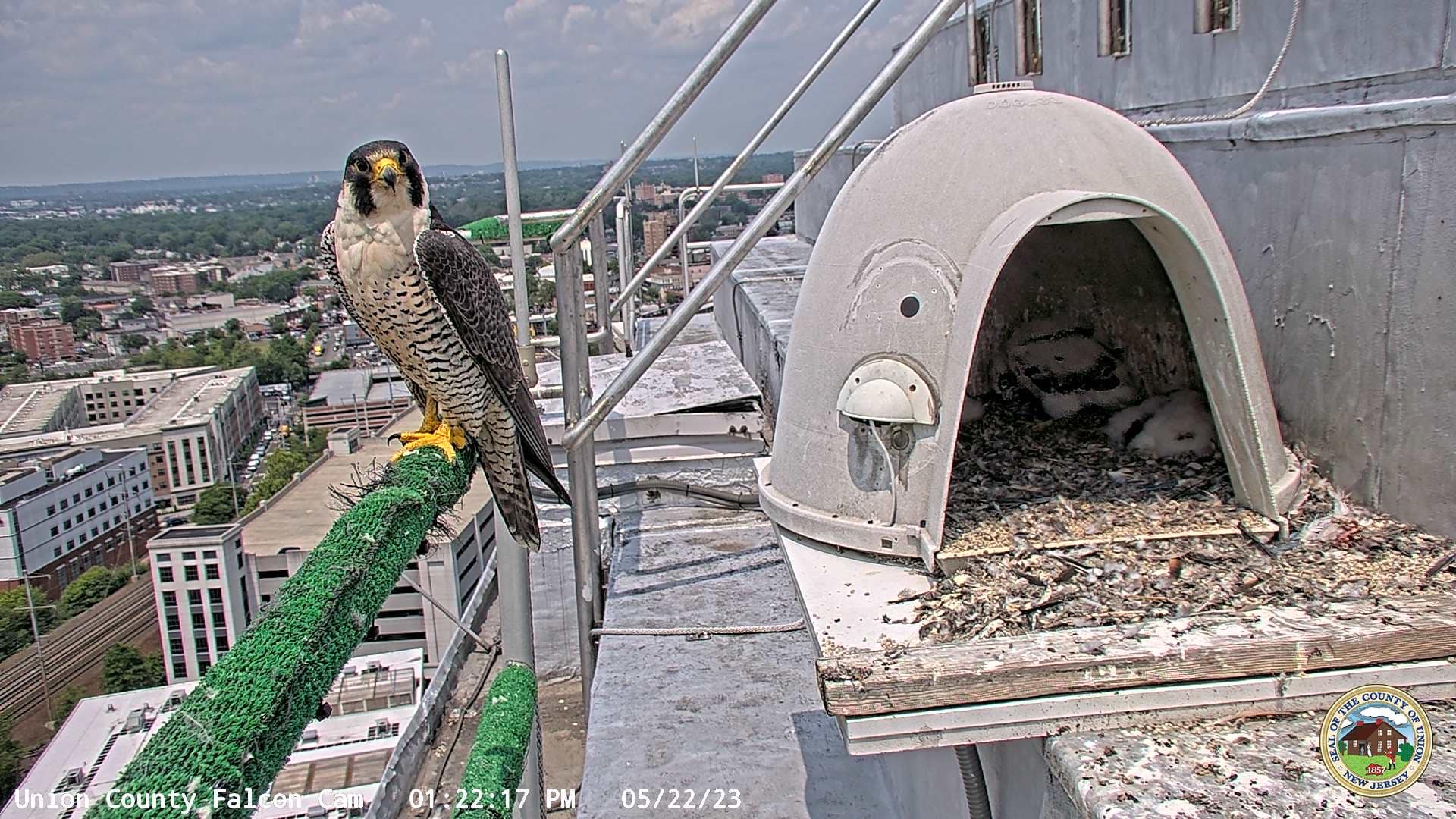
In early 2025, the status of peregrine falcons in New Jersey was upgraded to threatened by NJDEP. This is despite small dips or declines in their annual productivity observed over the preceding two years and adult turnover (replacement of adults) at established was high at 48% in 2024. This was observed mainly within the coastal population, formally the core of the breeding population that nest atop old hacking towers, where 57% (24 of 42) of known adults went missing. Now the most productive regions are inland and urban areas, where nests are found on bridges and buildings.
Is is unknown what caused the swift loss of breeding age adults in a year as previously documented turnover rates of adults was between 15% and 20% in any year. In addition, three coastal nest sites were completely abandoned, which is very unusual as previously they were highly sought after by breeding age adult falcons. Biologists are unsure of the impacts of HPAI on falcons in coastal New Jersey and are monitoring the population closely in 2025.
Scientific Classification
- Kingdom: Animalia
- Phylum: Chordata
- Class: Aves
- Order: Falconiformes
- Family: Falconidae
- Genus: Falco
- Species: F. peregrinus