Conserve Wildlife Blog

Posts Tagged ‘red knot’

Great Shorebird Viewing Opportunities…

Sunday, April 22nd, 2012
…found at Delaware Bay beaches in May.

by Larissa Smith, biologist/volunteer manager

Reeds Beach: Closed area marked with signs and rope. In the background is the viewing platform © Ben Wurst

Several Delaware Bay beaches will be closed from Monday, May 7 to Thursday, June 7, 2012.  Beaches are closed to protect a rapidly-declining population of migrating shorebirds including the red knot which is an endangered species in NJ.  But this doesn’t mean that you can’t come out and view the shorebirds and horseshoe crabs. It’s the prefect time to see these birds undisturbed and feeding on horseshoe crab eggs.

Several beaches are set-up for shorebird viewing including Reeds Beach, Norburys Landing, Kimbles Beach and Cooks Beach in Cape May County. Find more viewing locations on our interactive Wildlife Viewing Map.

Shorebird Stewards will be present at closed beaches to educate the public about the interaction between the shorebirds and horseshoe crabs. Take some time this May and come visit the Delaware Bay and enjoy the view!

Detailed maps of the closed areas can be found at:

http://www.state.nj.us/dep/fgw/ensp/beachclozmap.htm


News from the International Shorebird Project

Tuesday, September 13th, 2011
Red knot shot while on migration

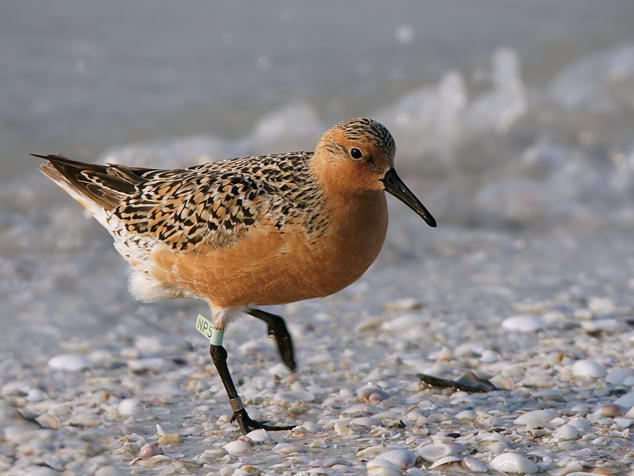
A banded red knot searches for food on a Delaware Bay beach.

Bandedbirds.org is an effort to collect data on shorebirds throughout their range from the southern tip of Chile to the Canadian arctic. This effort has been underway for many years and has an international network of volunteers reporting re-sightings data on shorebirds. 

The following was shared with the shorebird community by Jeannine Parvin, administrator for bandedbirds.org.

The bird being discussed was banded in NJ in May 2005.  It seemed to return to NJ each year, having been resighted most years up to 2010.  The bird seemed to be heading back up to NJ for the 2011 Spring shorebird season, when it was shot and killed in French Guiana.  Illegal hunting is still a big issue for shorebirds.  Paired with loss and degradation of habitat, and pollution, these birds face major threats.  Read more about CWF’s work to monitor and protect shorebirds here.

A red knot identified as FL(PPM) was shot in French Guiana by a hunter.

The data was submitted by Alexandre Vinot from French Guiana. He regularly reports to bandedbirds.org and is a volunteer with GEPOG.

His comments state: “shot in Mana Ricefield – flag given to Antoine Hausselman, who gave me the data”.

5.651519 -53.670960 approximates this location along NW coast of French Guiana. (more…)

Brigantine Shorebird Study

Wednesday, October 13th, 2010
Volunteers are needed to help study migratory shorebird distribution and human use

A large flock of migratory shorebirds at North Brigantine Natural Area. © Ben Wurst

A partnership between Conserve Wildlife Foundation of NJ, Endangered and Nongame Species Program, and Rutgers University.

Survey Period: 10/13/2010 – 10/24/2010

Volunteers are needed to help conduct a study that will measure all influences of shorebird distribution (food, predation and human use/disturbance) while altering human recreational use (close sections of beach, restricted access to key areas or to the waterline) to determine impact both to recreational use and shorebirds at a coastal stopover site (North Brigantine Natural Area). Volunteers are needed to survey shorebird behavior and distribution and/or human use of the natural area.

The ultimate goal is to recommend management programs that create the best protection with minimal impact to recreational use to all Federal and State agencies responsible for sites important to migratory shorebirds.


Shorebird Study:

Volunteers/interns must have the ability to:

  1. Identify shorebird species including Red Knot, Semi-palmated Plover, Sanderling, Sandpiper spp., Dunlin, Ruddy Turnstone is required.
  2. Accurately observe and record estimates of flock size and behaviors.
  3. Work anywhere 11-hour days with breaks throughout the day on site as needed.
  4. Walk several miles on the beach throughout the shift.
  5. Communicate effectively, intelligently and positively with the public despite potential opposition.
  6. Provide own transportation to Brigantine Natural Area.
  7. Lodging will be provided for those traveling and/or working consecutive days.

Human Use Study:

Volunteers/interns must have the ability to:

  1. Communicate effectively, intelligently and positively about the study with the public despite potential opposition. Volunteers will be supplied with a 1-page hand out about the project with contact information to share with the public.
  2. Advise public of beach closure.
  3. Interview visitors where possible to establish recreational activities, recreational rates, and perceptions.
  4. Accurately record responses.
  5. Work 11 hour days (includes two weekends) with breaks as needed on site throughout the day.
  6. Provide own transportation to Brigantine Natural Area.
  7. Lodging is available for those traveling and working consecutive days.

The schedule will be composed of 11-hour daily survey periods over the course of 12 consecutive days. This includes three pre-treatment days (10/13-10/15) followed by six treatment (beach closure) days (10/16-10/21) and three post-treatment days (10/22-10/24). Obviously, greater availability is preferred but flexible scheduling will be considered. We would like to keep this project a volunteer/intern support survey, so pay is not likely although may be considered if we are able to identify additional funding.

Please contact Cristina Frank at cristina_frank@hotmail.com if you’d like to volunteer.

Fall Migration is Underway!

Wednesday, September 8th, 2010
Viewing Wildlife and migration studies

by Ben Wurst, Habitat Program Manager

A juvenile black skimmer is viewed through a spotting scope at Forsythe NWR in Oceanville, NJ. © Ben Wurst

Fall migration is underway! Ospreys are headed south for the winter. Juveniles will spend the next two years in their wintering areas in northern South America. Rob Bierregaard, from the University of North Carolina at Charlotte has been tracking ospreys from Martha’s Vineyard since 2000. Currently twelve ospreys are fitted with satellite transmitters. Rob uses the data to study migration patterns and the local dispersal of juvenile and adult ospreys. Check out maps from this seasons birds by clicking here. A great place to view ospreys as they travel south is at Cape May Point State Park. Go after a cold front has passed and you should see high numbers of raptors including ospreys on migration.

Red knots, black belly plovers, dunlin, and ruddy turnstones are beginning to show up on beaches along the coastline. Many hop-scotch their way south to their wintering grounds in South America. Great places to view them include Brigantine Inlet, Avalon, Stone Harbor Point, and North Wildwood. Many of these shorebirds are banded with an alpha-numeric color band. If you have a high power spotting scope, then you should be able to read the band. You can contribute your sightings to the International Shorebird Project by submitting your sightings.

Another great website that tracks avian (bird) migration patterns over New Jersey is www.woodcreeper.com. It is run by David La Puma who uses Doppler radar to track movements of birds as they take off on migration, most at night. He is predicting that a large number of birds will take off Wednesday night/Thursday morning after a cold front with winds that prevail from the north passes through. He expects large numbers of migrants to arrive here to “rest and refuel” on Thursday/Friday. Check out this cool graphic of some Doppler radar where you can see birds moving behind the passing cold front (with precipitation).

Get out this weekend and enjoy the beautiful fall weather and watch some of the amazing natural events that take place in New Jersey. Learn key locations to view wildlife by visiting our wildlife viewing map.

Shorebird Stewards

Friday, June 18th, 2010
Helping to protect shorebirds on the Delaware Bay

By Larissa Smith, Assistant Biologist

Visitors to Reeds Beach discuss the shorebird season with Shorebird Steward Jim May.

One part of my job that is quite enjoyable is getting to spend time on the Delaware Bay beaches in the spring and working with the Shorebird Stewards.  As the CWF volunteer manager I organize the Shorebird Steward program which is part of the International Shorebird Project. During the two week period that stewards are on the beaches I try to get out and check on the beaches and meet with the stewards as much as possible.  This season there were 26 stewards and 23 of those had worked as stewards during a previous season.

The main part of the steward’s job is to educate people about the shorebirds and horseshoe crabs, but they do a lot more than that in a day.  Stewards also keep people from going into the closed areas of the beaches so that the shorebirds can feed undisturbed.  They give directions and send people to the beaches where the most birds have been sighted that day.

Shorebird Steward Rochelle Gimmillaro points out shorebirds to visitors to Cook’s beach.

If they have time they also count the number of shorebirds on the beaches and if possible record any banded birds that they see. Stewards deal with all types of people and situations. Some beaches are much busier than others, such as Reed’s beach where there is a viewing platform.  On many days there is a constant stream of people coming to the view the shorebirds and horseshoe crabs.

This season there were very few problems on the beaches and it is directly due to the shorebird stewards hard work and dedication to the project.

I look forward to getting back on the beaches next shorebird season and working with such a great group of volunteers.